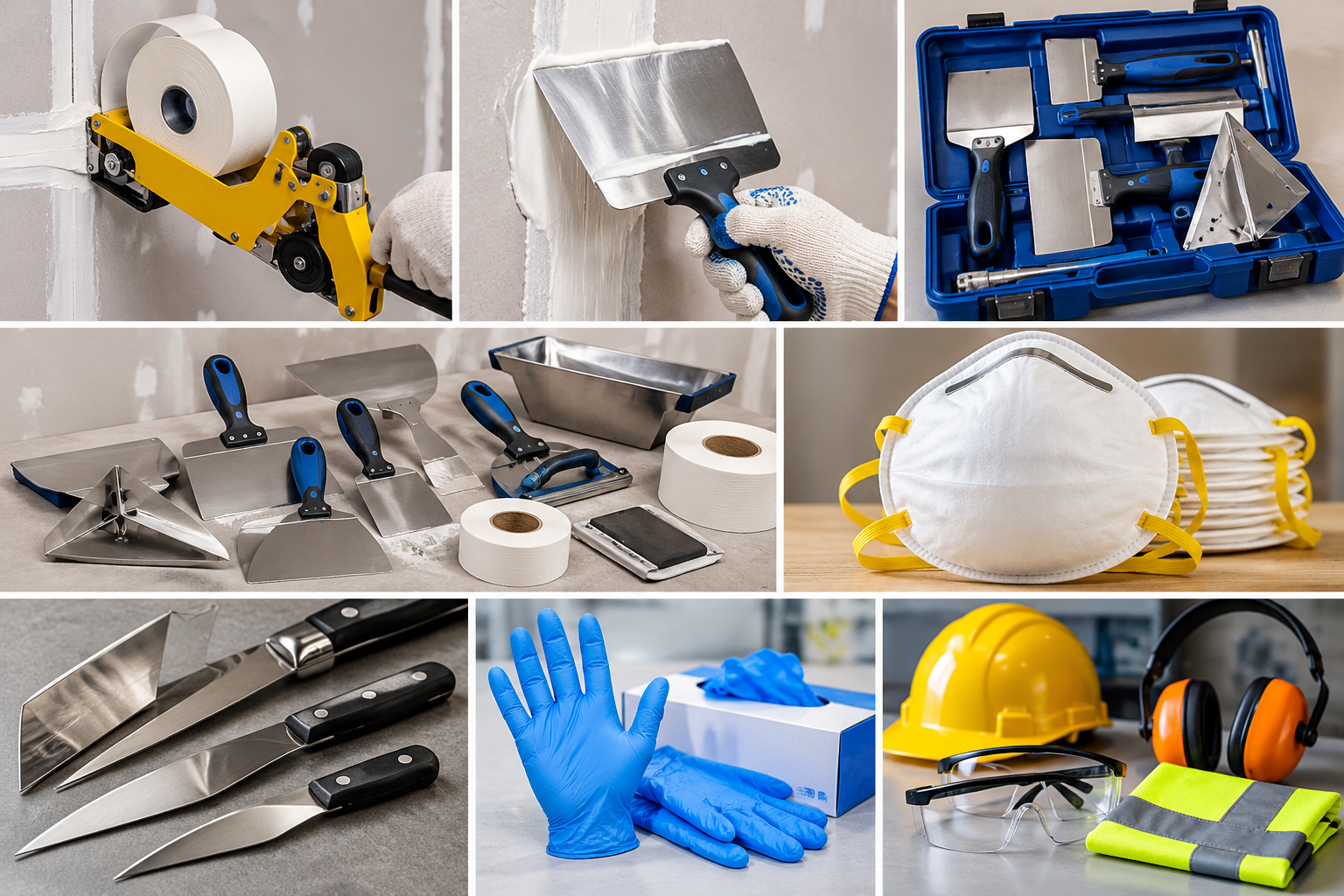
Large drywall finishing projects involve repetitive tasks that demand accuracy and consistency. Workers must apply joint compound, embed reinforcing tape, finish seams, and smooth corners while maintaining a uniform appearance.
A carefully selected drywall taping tool set can help organize these activities and improve workflow efficiency.
Rather than treating every finishing operation separately, a coordinated collection of tools allows workers to move through the project with fewer interruptions.
Why a Complete Tool Set Matters
Drywall finishing involves several stages, and each stage requires a different application technique.
Using unsuitable equipment can create uneven compound coverage, excessive sanding, or unnecessary rework.
A coordinated set supports consistent application across flat joints, corners, and finishing surfaces.
Understanding the Finishing Sequence
The process typically begins with preparing drywall seams and applying reinforcing tape.
Additional compound coats conceal the tape and gradually blend the joints into the surrounding wall.
Inside corners and fastener locations also require attention.
Final inspection and sanding prepare the surface for decoration.
Essential Components of a Drywall Taping Tool Set
The exact contents of a tool set vary according to its intended applications.
Automatic Taping Equipment
Automatic taping equipment can apply joint compound and reinforcing tape together.
This helps workers complete repeated seams without separately handling both materials during every application.
Proper adjustment and operator technique remain essential for consistent results.
Flat Finishing Boxes
Flat finishing boxes distribute compound across drywall joints.
Different widths may be used as the finishing process progresses.
Wider applications help create gradual transitions that become less noticeable after painting.
Corner Finishing Equipment
Inside corners present challenges because two surfaces intersect.
Specialized corner finishing tools help apply and shape compound along these intersections.
Correct positioning reduces the likelihood of uneven buildup.
Filling and Handling Accessories
Automatic finishing equipment often requires compatible filling systems and extension handles.
These components support material transfer and access to elevated surfaces.
Compatibility should always be verified before assembling a complete system.
Choosing Equipment for Different Project Sizes
A drywall taping tool set should match the type and scale of work being performed.
Residential Renovations
Smaller projects often include narrow spaces, short joints, and detailed repairs.
Compact equipment and versatile hand tools may provide better control in these conditions.
Commercial Construction
Large projects frequently involve extensive wall and ceiling surfaces.
Automatic equipment may improve productivity when workers perform repeated finishing operations.
However, setup time, maintenance, and training requirements should be considered.
Evaluating Tool Quality and Compatibility
Before selecting a drywall taping tool set, inspect the construction and operating characteristics of its components.
Moving parts should function smoothly, and adjustment mechanisms should be accessible.
Handles should provide comfortable control during extended use.
Tool compatibility is particularly important when combining equipment from different systems.
Consider Maintenance Requirements
Automatic equipment contains internal passages, seals, and mechanical components that require cleaning.
Choose tools that can be maintained according to available instructions.
Easy access to wear components can simplify routine maintenance.
Developing an Efficient Finishing Workflow
Organize equipment according to the order of work.
Prepare joint compound before loading automatic tools.
Complete similar tasks together where practical to reduce repeated equipment changes.
Maintain consistent application pressure and inspect finished areas before proceeding.
Avoiding Common Application Errors
Excess compound can increase drying time and sanding requirements.
Insufficient material may leave visible joints or poorly embedded tape.
Incorrect equipment adjustments can also cause uneven application.
Testing settings on a small section helps identify problems before beginning extensive work.
Training and Safe Operation
Workers should understand the operating instructions for each component.
Automatic tools require familiarity with filling procedures, adjustments, and cleaning methods.
Extension equipment should be handled carefully, particularly when working overhead.
Proper training supports both finishing quality and equipment longevity.
Conclusion
A drywall taping tool set provides an organized approach to complex finishing tasks. Combining suitable taping, filling, and finishing equipment can improve consistency and reduce unnecessary interruptions.
The best results come from matching tools to project requirements, understanding their operating characteristics, and maintaining them properly.
With an efficient workflow and careful application techniques, drywall finishing becomes more manageable across projects of different sizes.